
UEFA Champions League 2026/27 League Phase: Standings, Rules & Qualification Math
Europe’s premier club competition is back, and the battle across the continent has reached fever pitch. Following an explosive opening round of 18 fixtures across Europe, the UEFA Champions League 2026/27 league phase has officially taken shape in a single, high-stakes 36-team league table.
Gone are the traditional four-team groups of old. Instead, football fans are treated to an eight-game marathon where every single goal, point, and tactical substitution directly shifts a club’s standing across the entire continent. Heavyweights like Paris Saint-Germain, Bayern Munich, Barcelona, and Manchester United opened their European campaigns with decisive victories, but the journey to the knockout rounds is only just getting started.
Whether you need a refresher on the tournament rules, want to understand the points threshold needed to finish in the top eight, or want to scout the biggest upcoming clashes, here is your definitive guide to the 2026/27 campaign.
The 36-Team System: How the League Phase Operates
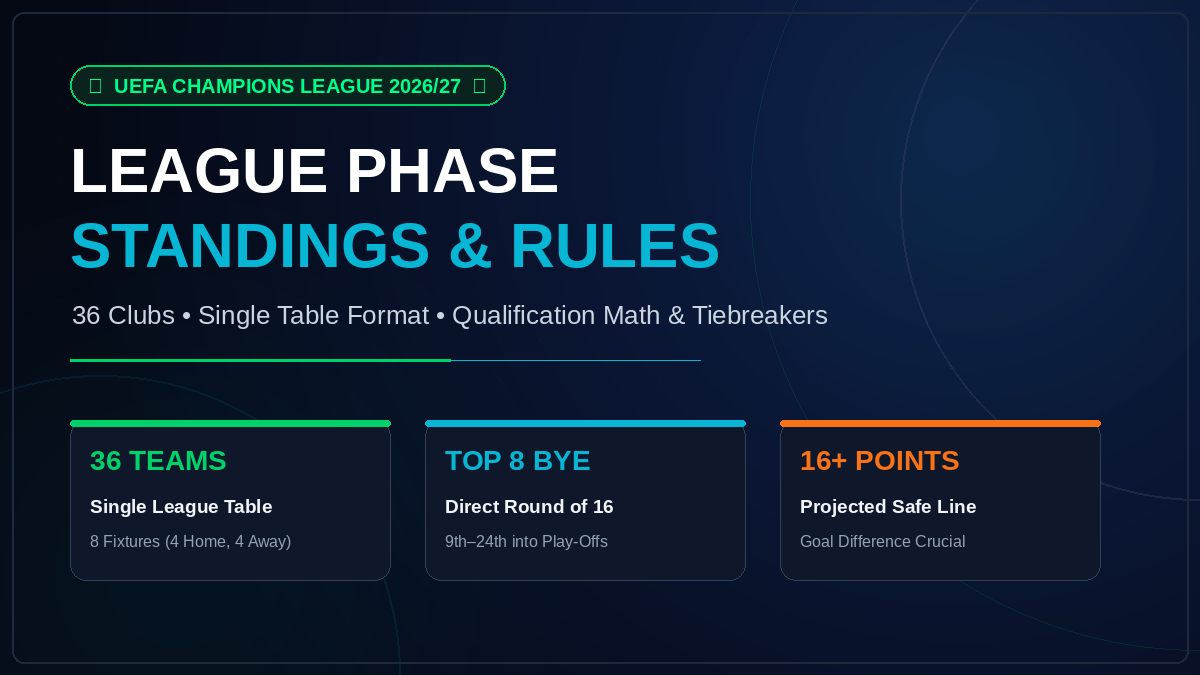
The 2026/27 tournament features 36 clubs competing in one unified league table. Rather than playing three opponents home and away, each club faces eight different opponents (four matches at home and four matches away) drawn from four seeded pots.
The progression rules are straightforward yet unforgiving:
- Top 8 Clubs (1st to 8th): Qualify automatically for the Round of 16 as seeded teams, earning a crucial bye past the winter play-off round.
- Clubs Ranked 9th to 24th: Enter a two-legged knockout phase play-off in February 2027 to fight for the remaining eight Round of 16 spots.
- Clubs Ranked 25th to 36th: Eliminated directly from European competition with no safety net or drop into the UEFA Europa League.
As confirmed by the UEFA Official Match Calendar Regulations, this format guarantees that matches all the way through Matchday 8 in late January 2027 retain massive qualification consequences.
Current Standings & Early Matchday Leaders
Opening matchdays in European football often deliver statement scorelines, and Matchday 1 was no exception. Several traditional powerhouses delivered dominant attacking displays to establish early command of the single table.
| Pos | Club | Played | W-D-L | GF:GA | GD | Points |
|---|---|---|---|---|---|---|
| 1 | Paris Saint-Germain | 1 | 1-0-0 | 6:1 | +5 | 3 |
| 2 | Bayern Munich | 1 | 1-0-0 | 5:0 | +5 | 3 |
| 3 | FC Barcelona | 1 | 1-0-0 | 5:1 | +4 | 3 |
| 4 | Manchester United | 1 | 1-0-0 | 4:0 | +4 | 3 |
| 5 | Como 1907 | 1 | 1-0-0 | 4:1 | +3 | 3 |
| 6 | Real Madrid | 1 | 1-0-0 | 2:1 | +1 | 3 |
Check the live updated table on the UEFA Champions League official standings portal.
The Original Angle: Why Goal Difference Is Europe’s Deadliest Tiebreaker
Under the old group system, managers who were two goals up with twenty minutes remaining routinely substituted star forwards to preserve energy. In the modern UEFA Champions League 2026/27 league phase, taking your foot off the gas is tactical self-sabotage.
With 36 clubs competing in a single table across just eight matchdays, points ties are inevitable. At the conclusion of Matchday 8, anywhere from four to seven clubs frequently finish level on 15 or 16 points hovering around the 8th-place qualification boundary.
Because head-to-head records cannot resolve ties between teams that never played one another, overall goal difference serves as the primary tiebreaker. Bayern Munich’s five-goal blitz and PSG’s six-goal output were not mere stat-padding; they represent crucial insurance policies that could prove the difference between earning a direct Round of 16 bye or enduring two bruising extra knockout playoff ties in February.
The Magic Number: How Many Points Do Clubs Need?
Statistical simulations and tournament modeling provide clear benchmarks for what managers must target over their eight league phase fixtures:
1. Direct Round of 16 Qualification (Top 8): 16–17 Points
To avoid the play-off round entirely, teams typically need at least five wins and a draw (16 points) alongside a positive goal differential (+6 or better). Reaching 17 points guarantees safety into the top eight in virtually all modeling scenarios.
2. Play-off Safety (Top 24): 9–10 Points
Clubs aiming to survive elimination and secure a 9th-to-24th play-off berth need roughly three victories or two wins and three draws (9 to 10 points). In tight races, teams on 9 points with poor defensive records risk falling into the bottom twelve.
Tactical Trends: The Death of Defensive Coasting
The single-table format has fundamentally altered tactical management across Europe’s top leagues. Managers can no longer “write off” tough away trips to the Santiago Bernabéu, San Siro, or Allianz Arena.
In previous seasons, a club losing 2-0 away to a European powerhouse could sit back, shut down space, and happily accept a respectable defeat. In the current league phase, conceding a third or fourth goal severely damages your league rank. As a result, we are witnessing teams push higher up the pitch even when trailing, producing more end-to-end chaos, transitional transitions, and dramatic late-game swings.
What This Means Next: Matchday 2 Dates & Marquee Fixtures
The competition resumes with Matchday 2 taking place on October 13 and 14, 2026. Key storylines to watch include:
- Heavyweight Clashes: European giants that dropped points on Matchday 1 face immediate pressure to rebound before the midpoint of the league phase.
- Dark Horse Momentum: Surprise starters will look to consolidate their early top-eight positions before fixture congestion peaks in November.
- Squad Rotation Challenges: Domestic title contenders must balance high-stakes weekend league matches with midweek European travel.
Frequently Asked Questions (FAQs)
How does the UEFA Champions League 2026/27 league phase work?
All 36 qualified clubs are placed into a single league table. Each team plays eight games against eight different opponents (four home, four away). The top eight advance directly to the Round of 16, teams placed 9th to 24th enter a two-legged play-off, and the bottom 12 clubs are eliminated.
How many teams qualify directly for the Round of 16?
Exactly eight teams earn direct automatic qualification into the Round of 16, where they will be seeded against the eight winners of the knockout phase play-offs.
What happens if teams finish tied on points in the league table?
If two or more clubs finish with identical points, UEFA applies the following tiebreakers: superior goal difference in the league phase, higher number of goals scored, higher number of away goals scored, and total number of wins.
Do eliminated Champions League clubs drop down to the Europa League?
No. Under the current format, there is no transfer of clubs between European competitions. Teams finishing 25th through 36th exit European football entirely for the remainder of the season.
Where and when is the 2027 UEFA Champions League final?
The 2026/27 UEFA Champions League final will take place on Saturday, June 5, 2027, at the Estadio Metropolitano in Madrid, Spain.
Final Verdict
The UEFA Champions League 2026/27 league phase has revitalized European football by ensuring every fixture carries genuine continental weight. With heavy hitters racking up dominant scorelines and mid-table sides battling for crucial survival points, the race to the top eight will come down to fine tactical margins. As Matchday 2 approaches in October, expect the intensity and drama to reach even greater heights.