iPhone 18 Pro Max vs Galaxy S26 Ultra: 5 Big Differences
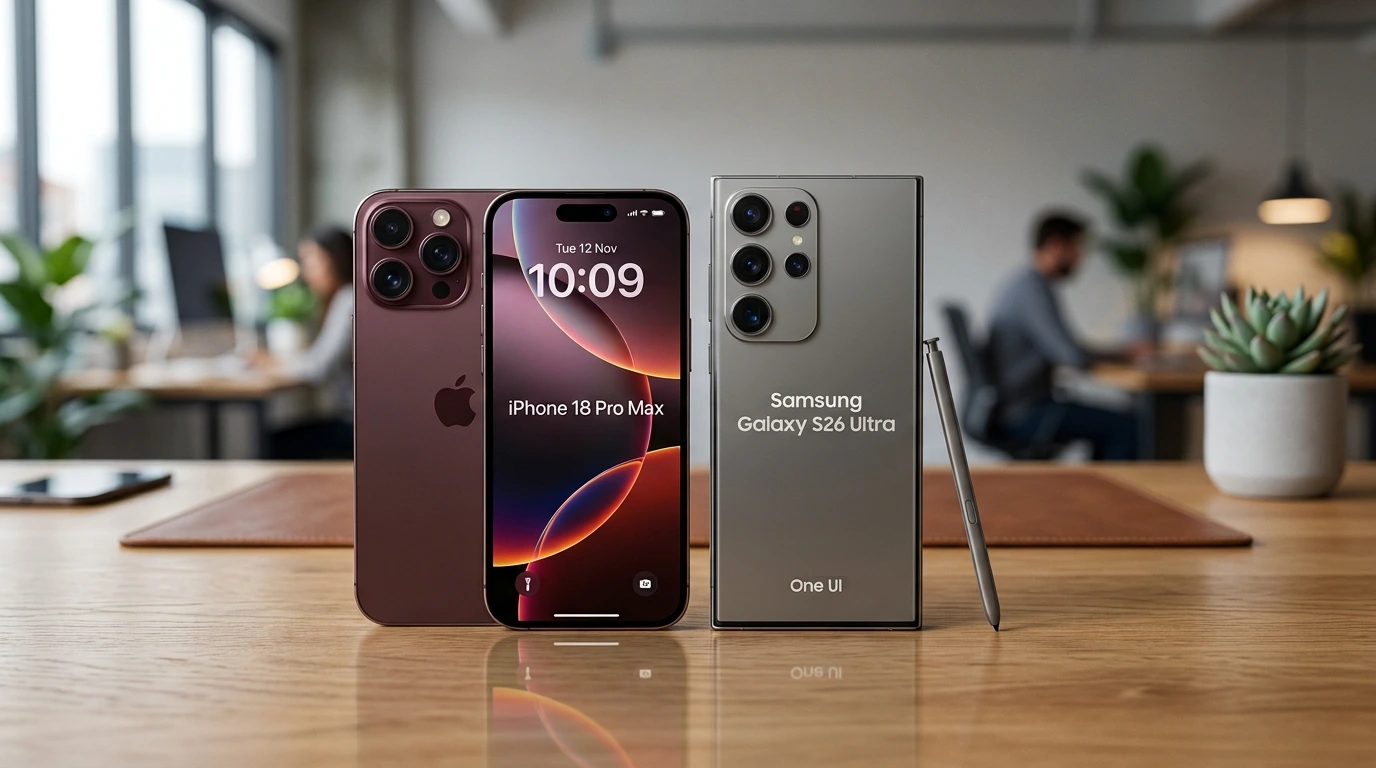
If you have around $1,300, £1,250, or €1,450 burning a hole in your pocket for an ultra-tier smartphone right now, you are staring at the toughest decision in years. On one side, Apple has finally transitioned to cutting-edge 2nm silicon and added a physical variable-aperture camera to the iPhone 18 Pro series. On the other, Samsung’s mature Galaxy S26 Ultra offers a 200MP sensor, a built-in S Pen, and an anti-reflective display that remains unmatched in direct sunlight.
Both handsets are remarkable achievements, but they cater to very different daily habits. Let’s bypass the marketing buzzwords and break down how these two giants compare where it actually matters.
⚡ Key Takeaways
- Size Options: If you want a pocketable flagship, the 6.3-inch iPhone 18 Pro gives you full Pro power for $100 less. If you want maximum screen real estate, both the 18 Pro Max and S26 Ultra offer massive 6.9-inch panels.
- Performance: Apple’s 2nm A20 Pro features a triple-size vapor chamber that eliminates thermal throttling; Samsung’s custom Snapdragon 8 Elite Gen 5 provides effortless multitasking with up to 16GB RAM.
- Camera Styles: Apple went with mechanical variable aperture (ƒ/1.48 to ƒ/4.0) for natural optical depth of field and cinema-grade video. Samsung leans on pure optical reach with dedicated 3x and 5x zoom lenses.
- Everyday Handling: Despite sharing a 6.9-inch screen size, the Galaxy S26 Ultra is noticeably lighter in the hand (214g vs. Apple’s 249g).
Quick Specs Comparison
| Feature | Apple iPhone 18 Pro Max | Samsung Galaxy S26 Ultra |
|---|---|---|
| Display | 6.9-inch Super Retina XDR OLED (120Hz ProMotion) | 6.9-inch Dynamic AMOLED 2X QHD+ (120Hz, Anti-Reflective) |
| Processor | Apple A20 Pro (2nm) | Qualcomm Snapdragon 8 Elite Gen 5 for Galaxy (3nm) |
| RAM | 8GB Unified Memory | 12GB / 16GB LPDDR5X |
| Storage Options | 256GB / 512GB / 1TB / 2TB | 256GB / 512GB / 1TB |
| Main Camera | 48MP Fusion with Stepped Variable Aperture (ƒ/1.48–ƒ/4.0) | 200MP Wide (ƒ/1.7, OIS) |
| Zoom Optics | 12MP 5x Tetraprism Periscope | 10MP 3x Optical + 50MP 5x Periscope (100x Space Zoom) |
| Battery & Charging | Up to 45h video; 50% in 15 mins (USB-PD) | 5,000 mAh; 60W Wired (75% in 30 mins) |
| Weight | 249 g (8.78 oz) | 214 g (7.55 oz) |
| Starting Price | $1,299 / £1,299 / €1,599 | $1,299 / £1,249 / €1,449 |
Price and Regional Realities: US, UK, and Europe
At launch, both titans start at $1,299 in the United States for a 256GB baseline configuration. However, if you are buying in the UK or mainland Europe, tax structures and launch timing create a noticeable price difference:
- United States: iPhone 18 Pro ($1,199) | iPhone 18 Pro Max ($1,299) | Galaxy S26 Ultra ($1,299) (before local state taxes)
- United Kingdom: iPhone 18 Pro (£1,199) | iPhone 18 Pro Max (£1,299) | Galaxy S26 Ultra (£1,249) (VAT included)
- Europe: iPhone 18 Pro (€1,449) | iPhone 18 Pro Max (€1,599) | Galaxy S26 Ultra (€1,449) (VAT included)
The Value Twist: The Galaxy S26 Ultra launched earlier in the year, which means carrier deals, trade-in bonuses, and retailer discounts are abundant right now. Apple’s newly released iPhone 18 Pro models sell firmly at full retail MSRP. If raw price-to-performance is your guiding metric, Samsung often edges ahead on street price.
Design and Ergonomics: The Weight Difference is Real
Put both phones on a table, and they look like slabs of minimalist luxury. Apple’s chassis comes in Deep Black, Silver, Glacier, and an eye-catching Burgundy. Samsung counters with industrial Titanium Gray, Black, and Violet tones.
However, the moment you pick them up, your hands will feel the difference:
- The iPhone 18 Pro Max weighs 249 grams. That extra heft comes from Apple’s dense internal cooling structure and reinforced perimeter.
- The Galaxy S26 Ultra weighs 214 grams. That 35-gram difference sounds trivial on paper, but after twenty minutes of one-handed reading or texting, Samsung feels noticeably more comfortable.
If pocket comfort is your priority, do not forget the 6.3-inch standard iPhone 18 Pro. It packs the exact same A20 Pro chip, camera hardware, and display technology as the Max, but in a footprint that won’t pull your sweatpants down.
Display: Glare Resistance vs. Smooth Software Integration
Both phones deliver breathtaking, buttery-smooth 120Hz OLED panels, but Samsung has a distinct hardware advantage: Corning Gorilla Armor anti-reflective glass.
If you use your phone on the London Underground under harsh tube lighting or outside in bright Mediterranean or California sun, the Galaxy S26 Ultra cuts ambient glare by nearly 75%. Text stays readable without cranking brightness to maximum. Plus, the S26 Ultra delivers native QHD+ resolution (3120 x 1440) alongside its built-in, low-latency S Pen stylus.
Apple’s Super Retina XDR display on the 18 Pro Max matches Samsung on contrast and color accuracy, and the Dynamic Island remains cleaner for real-time flight tracking, food deliveries, and playback controls. But for note-taking and signature signing, the S Pen gives Samsung a permanent productivity win.
Performance: TSMC 2nm A20 Pro vs. Snapdragon 8 Elite
Under the hood, silicon fabrication hits a major milestone.
The iPhone 18 Pro family features Apple’s A20 Pro, built on TSMC’s next-generation 2nm node. More importantly, Apple redesigned the internal logic board with a vapor chamber boasting three times the surface area of older models. The result? A massive 40% increase in sustained performance. Extended 4K gaming or heavy ProRes recording runs cool without aggressive frame drops.
Samsung’s Snapdragon 8 Elite Gen 5 for Galaxy is no slouch either. Paired with either 12GB or 16GB of LPDDR5X RAM, the S26 Ultra remains the undisputed champion of heavy multitasking. Hook it up to a monitor with Samsung DeX, and you practically have a portable desktop computer.
Cameras: Optical Variable Aperture vs. Sheer Zoom Power
This is the biggest philosophical split between the two brands.
Apple’s Mechanical Variable Aperture
Instead of relying entirely on software algorithms to blur your background, the iPhone 18 Pro main camera has an actual mechanical shutter opening and closing across distinct f-stops (ƒ/1.48 to ƒ/4.0):
- Shoot at ƒ/1.48 in low light or for rich, creamy portraits.
- Step down to ƒ/4.0 for architectural shots or group photos so every face stays tack-sharp from front to back.
- For videographers, 4K 120fps Dolby Vision and ProRes Log remain the gold standard in mobile filmmaking.
Samsung’s Zoom Supremacy
Where Apple focuses on cinema-grade consistency, Samsung focuses on versatility. With dedicated 3x and 5x optical lenses flanking a massive 200MP sensor, the S26 Ultra runs circles around the iPhone at 10x, 20x, and 30x magnification. If you frequently attend stadium concerts or sporting events, the Ultra’s zoom remains unmatched.
Battery Life and Charging Speeds
Both devices easily power through a full day of intensive use, but their charging styles differ:
- Galaxy S26 Ultra: Packed with a 5,000 mAh battery supporting 60W wired charging. Using a compatible charger, you can reach roughly 75% in 30 minutes.
- iPhone 18 Pro Max: Apple rates video playback at an astonishing 45 hours. While Apple does not advertise peak wattage numbers, its battery protocol reaches 50% in roughly 15 minutes, making quick morning top-ups painless.
Frequently Asked Questions
Does the iPhone 18 Pro Max support an Apple Pencil?
No. Apple keeps stylus support strictly on the iPad. If writing handwritten notes, marking up PDFs, or drawing directly on your phone screen is essential to your workflow, the Galaxy S26 Ultra with its built-in S Pen is the only choice here.
Can the Galaxy S26 Ultra shoot pro-level video like the iPhone?
The Galaxy S26 Ultra shoots sharp 8K at 30fps and 4K at 120fps with excellent stabilization. However, creative professionals still favor the iPhone 18 Pro Max for its Log color profile, ProRes recording pipelines, and optical variable aperture.
How does Apple Intelligence compare to Galaxy AI in the UK and Europe?
In the US, Apple Intelligence offers seamless on-screen context and cross-app Siri actions. However, in the European Union, certain cloud-based Apple Intelligence rollouts face regulatory reviews under the Digital Markets Act (DMA). Galaxy AI runs a hybrid on-device and localized cloud model that is already fully compliant and functional across the UK and EU.
The Verdict: Which One Should You Buy?
There is no bad choice here, but there is a clear right choice for your lifestyle:
- Buy the iPhone 18 Pro if you want top-tier processing, pro video tools, and the new variable aperture in a compact, hand-friendly 6.3-inch frame.
- Buy the iPhone 18 Pro Max if you want the longest battery life possible, unrivaled video recording, and a seamless connection to your Mac, iPad, and Apple Watch.
- Buy the Galaxy S26 Ultra if you want the best display for outdoor viewing, the productivity superpower of the S Pen, and stadium-worthy zoom cameras on an open Android platform.
What matters more to your daily routine: Apple’s optical variable aperture camera or Samsung’s built-in S Pen? Let us know in the comments below!
Sources & Technical References
- Apple Newsroom: Apple Debuts iPhone 18 Pro and iPhone 18 Pro Max
- Apple Technical Specifications: iPhone 18 Pro and 18 Pro Max Official Specs
- GSMArena Database: Samsung Galaxy S26 Ultra 5G Specifications
- PhoneArena: Siri AI Architecture & Hardware Integration
- The Economic Times: iPhone 18 Pro Max vs Galaxy S26 Ultra Comparison Guide